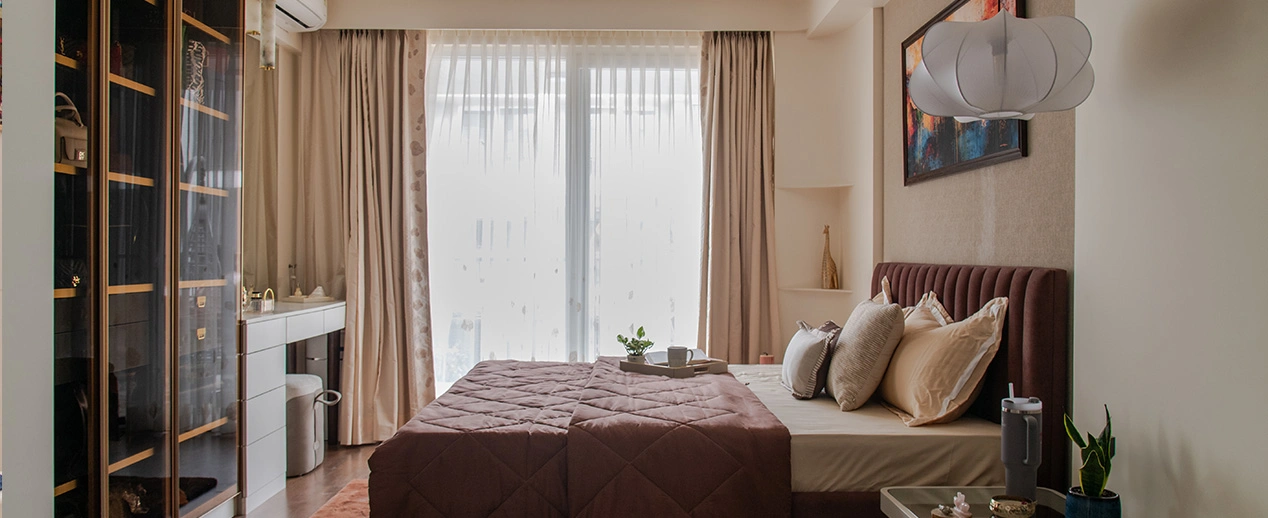
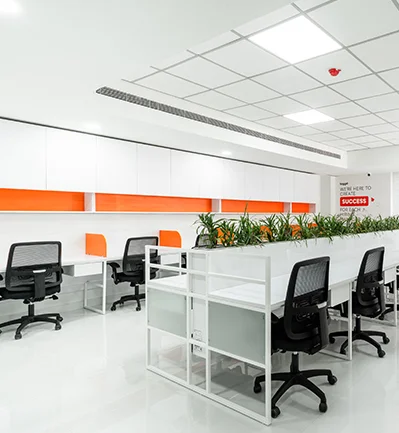
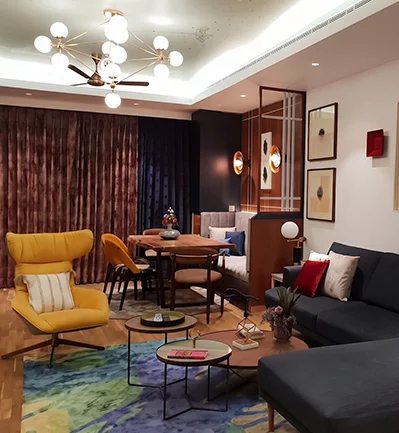
What Does "Turnkey" Actually Mean?
Here is a question worth asking: if you hire a designer and a contractor separately, who is responsible when something goes wrong?
The answer is usually no one. And that is the core problem.
Turnkey interior design solutions are different. They bring the entire process under one roof. One firm handles design, construction, procurement, civil work, and final handover. You hand over a key once, and you get it back when the space is completely ready. No chasing vendors. No playing middleman.
Here is what a true turnkey scope covers:
- Design and planning: Space layouts, mood boards, 3D visualizations, and material selection done by one team.
- Civil and structural work: Walls, flooring, ceilings, and plumbing handled by the same firm that designed the space.
- Electrical and MEP work: Mechanical, electrical, and plumbing planned together so nothing conflicts mid-execution.
- Custom carpentry and furniture: Built to match the design vision, not sourced from a generic catalog.
- Final styling and handover: The space is move-in ready. Nothing is pending. Nothing is left to chance.
Why Gurgaon Is the Epicenter of This Demand
Gurgaon is not a typical city. It is home to some of India's highest-earning professionals. Dual-income households are common. Corporate executives, startup founders, and NRIs investing in homes here do not have time to manage five different vendors.
North India holds the largest share at 29% of the total India interior design market in 2025, driven significantly by urban development and luxury convenience housing demand in the National Capital Region.
Turnkey interiors (design and execution combined) account for nearly 45% of the India interior design market by service model, the largest single category, driven by demand for end-to-end delivery.
That number tells its own story. Nearly half of all interior design spend in India now goes to firms that handle everything. The market is not fragmented anymore. The client has spoken.
And Gurgaon leads this shift. New residential projects are delivering premium 3 BHK and 4 BHK flats in DLF, Sohna Road, and Sector 90 at a pace that demands fast, coordinated execution. Buyers want their homes ready, not in progress.
The Real Cost of Managing It Yourself
So, what actually happens when you try to manage vendors yourself?
Most people underestimate it. They think hiring a carpenter and a painter and a civil team separately is cheaper. It rarely is.
- Hidden rework costs: When the civil team and the design team are not coordinated, walls get built in the wrong place. You pay to redo them.
- Timeline overruns: Each vendor waits for the other. A two-month project stretches to five.
- Decision fatigue: You are making 50 decisions a day. Wrong sofa dimensions. Wrong paint undertone. Wrong tile grout color.
- The average homeowner spends 150 or more hours sourcing furnishings online alone. Turnkey design gives that time back entirely.
Now multiply that by every category in your renovation. The time cost is enormous. And for a Gurgaon professional earning Rs. 3 to 5 lakh per month, every hour lost to coordination is real money.
What the Numbers Say About Turnkey's Rise
Data does not lie. The demand for structured, end-to-end design is growing fast.
The India Interior Design Market is projected at USD 31.43 billion in 2025 and is expected to reach USD 65.01 billion by 2031, growing at a CAGR of 12.87%. That growth is not being driven by decorators. It is being driven by firms that can execute.
India is projected to add around 20 million square feet of office space in 2024 alone, and approximately 5 million homes are expected to undergo renovation. This scale of activity demands the kind of coordinated execution that only turnkey firms can provide.
Here is a lesser-known fact: the design-build model is not just popular, it is measurably better. Research by the Design-Build Institute of America (DBIA) found that design-build projects are delivered up to 102% faster than traditional design-bid-build projects [DBIA.org]. Penn State University research also showed that design-build projects cost, on average, 6.1% less per unit than those handled by separate teams [engr.psu.edu].
The reason is simple. When one firm designs and builds, there is no blame game. There is no gap between what was designed and what gets built.
What Separates a Good Turnkey Partner from a Bad One
Not every firm that claims to be "turnkey" actually is. Many outsource execution while retaining only the design role. The client ends up coordinating anyway.
So, what should you look for?
- In-house execution teams: Not outsourced laborers. The carpenters, electricians, and civil crew should work under the firm's direct quality control.
- Transparent pricing upfront: A bill of quantities before work starts. No shock invoices at the end.
- Site visits within 48 hours of contract signing: A firm serious about precision starts measuring immediately.
- Defined milestones: A project calendar that tells you exactly what happens each week.
- Post-handover support: The team picks up your call after the keys are handed over.
As architect and author Francis D.K. Ching notes in Interior Design Illustrated (Wiley, 2012), "The built environment is not a product of isolated decisions. It is the sum of how well a team coordinates across disciplines."
That sentence is the entire argument for turnkey. Coordination is not a bonus feature. It is the product.
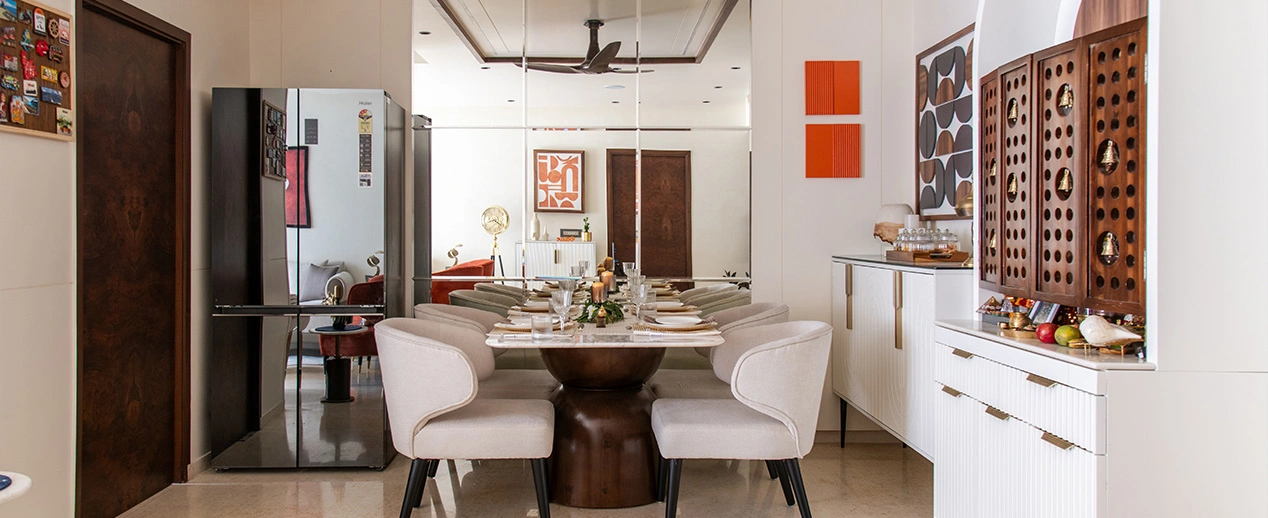
Turnkey Interior Contractors in Gurgaon: Why Military Precision Matters
There is one more factor that Gurgaon clients are beginning to value: discipline.
Construction and interior projects in India have a well-known reputation for delays. Contractors go missing. Painters show up on the wrong day. Materials arrive in the wrong color. A culture of vague timelines has made clients anxious.
That is where the background of a firm matters as much as its portfolio.
Turnkey interior contractors in Gurgaon who bring a structured, process-driven approach to execution stand out. Site visits are documented. Every decision is recorded. Estimates and mood boards are presented together so the client sees cost and design at the same time. Nothing moves to execution until it is signed off.
This kind of structure protects the client. It also protects the project.
How Colonelz Delivers on This Promise
Colonelz was founded by Col Biraj Sahay and Capt Lalita Sahay, both veterans with a military background. That background is not branding. It is a working method.
"At Colonelz, we shape spaces that reflect your aspirations, values, and lifestyle. Our commitment to military precision, creativity, and client-first thinking ensures every project exceeds expectations." — Col Biraj Sahay, Founder, Colonelz
Colonelz brings over 25 years of combined experience and has delivered more than 400,000 square feet across 250+ projects in Gurgaon and Delhi-NCR. Their turnkey interior design solutions cover residential homes, commercial offices, retail spaces, and architectural projects.
Here is how their process works in practice:
- A consultation begins with understanding your vision and goals.
- A curated mood board and ballpark cost estimate are presented together.
- A formal contract is signed before a single measurement is taken.
- A site visit happens within 48 hours of contract signing.
- A full timeline and detailed estimate follow based on the final scope.
This is not how most firms work. Most firms estimate loosely, begin work, and revise the cost three times before handover. Colonelz locks the scope before it locks the schedule.
And for turnkey interiors designer in Gurgaon who serve both residential and commercial clients, this kind of process discipline is rare.
Is a Turnkey Solution Worth the Investment?
This is the question every potential client asks.
Here is the honest answer: for someone with time, patience, and experience managing construction, a fragmented approach might work. But for most people, it does not.
Turnkey interior design solutions are not more expensive when you account for rework costs, time lost, and the mistakes that happen when teams are not coordinated. They are often more economical.
And beyond money, there is something that data cannot fully capture: peace of mind. You know who is responsible. You know what is happening each week. You know what the final cost will be before the first wall is touched.
That is not a luxury. That is basic accountability. And in Gurgaon's fast-moving design market, it is exactly what clients have been asking for.
The Demand Will Keep Growing
Gurgaon is adding new residential sectors, corporate campuses, and retail corridors every year. The people moving into these spaces are busy. They are ambitious. And they want their environments to match their standards without costing them their weekends.
Turnkey interiors designing solutions meet that need precisely. One firm, one contract, full responsibility.
If you are planning a home or office project and want to see what this looks like in practice, Colonelz offers an initial consultation that begins with your vision and ends with a clear plan.
That first conversation costs nothing. The peace of mind it leads to is priceless.
References
- IMARC Group. (2025). India Interior Design Market Report. imarcgroup.com. https://www.imarcgroup.com/india-interior-design-market
- Mordor Intelligence. (2026). India Interior Design Market Size & Forecast 2026–2031. mordorintelligence.com. https://www.mordorintelligence.com/industry-reports/india-interior-design-market
- Credence Research. (2026). India Interior Design Market by Service Model. credenceresearch.com. https://www.credenceresearch.com/report/india-interior-design-market
- Konchar, M., & Sanvido, V. (1998). Comparison of U.S. Project Delivery Systems. Penn State University, Department of Architectural Engineering. engr.psu.edu. https://www.engr.psu.edu/ae/research/
- Ching, F.D.K., & Binggeli, C. (2012). Interior Design Illustrated (3rd ed.). Wiley.
- Sukkha Interior Design. (2025). Turnkey Interior Design 101. sukkhainteriordesign.com. https://www.sukkhainteriordesign.com/blog/turnkey-interior-design-101
- Ken Research. (2025). India Interior Design Market, Strategic Roadmap 2030. kenresearch.com. https://www.kenresearch.com/industry-reports/india-interior-design-market
Frequently Asked Questions
Q1. What is the difference between a turnkey interior firm and a regular interior designer?
A regular interior designer gives you a design plan. A turnkey interior firm handles everything: design, civil work, electrical, carpentry, procurement, and final handover. You deal with one team from start to finish.
Q2. Are turnkey interior design solutions more expensive than hiring separate vendors?
Not necessarily. When you account for rework, delays, and coordination mistakes, turnkey projects often cost less. Research by the DBIA shows design-build projects cost up to 6.1% less on average than those handled by separate teams.
Q3. How long does a typical turnkey interior project take in Gurgaon?
Timeline depends on scope. A 2,000 sq ft residential project typically takes 8 to 14 weeks with a structured turnkey firm. Firms that plan properly before starting tend to finish faster than those that figure it out as they go.
Q4. Can I customize the design in a turnkey project, or is it a pre-set package?
Yes, customization is entirely possible. A good turnkey firm starts by understanding your preferences and builds the design around your requirements. The "turnkey" part refers to execution responsibility, not a fixed design catalog.
Q5. How do I verify if a turnkey interior firm in Gurgaon is genuinely end-to-end?
Ask specifically whether they have in-house execution teams or outsource labor. Ask to see a sample bill of quantities from a past project. Ask if they manage MEP (mechanical, electrical, plumbing) work internally. A genuine turnkey firm will answer all three with confidence.
 Residential Turnkey
 Residential Design Consultation
 Residential Construction
 Commercial Turnkey
 Commercial Construction
 Workspaces & Offices
 Architectural Turnkey
 Architectural Consultation
 Retail & Hospitality