What Are Working Drawings, and Why Do People Skip Them?
Most clients understand that design is important. But very few understand the difference between a concept design and a proper set of working drawings.
A concept design shows what a space will look like. A working drawing tells the contractor exactly how to build it.
Here is what a complete set of interior design working drawings typically includes:
- Floor plans with dimensions — Every wall, door, and partition is placed with precise measurements, so nothing is guesswork.
- Reflected ceiling plans (RCPs) — Exact positions of lights, fans, AC vents, and false ceiling grids, coordinated with civil and electrical work.
- Elevation drawings — Wall-by-wall views showing joinery heights, shelf positions, tile patterns, and finishes in accurate scale.
- Furniture layout drawings — Exact placement of every piece of furniture, helping you catch spatial issues before the carpenter shows up.
- Electrical and plumbing coordination drawings — Overlaid plans that show how mechanical systems interact with the design, preventing clashes.
- Joinery and millwork detail drawings — Blow-up sections of wardrobes, kitchens, and custom furniture that carpenters follow during fabrication.
- Material and finish schedules — A room-by-room specification list of every material, finish, and product being used.
Many clients skip this step to save time or money. That is the expensive mistake.
Why Skipping Drawings Costs You More Than the Drawings Ever Would
Here is a question worth sitting with: what actually happens when a contractor builds without proper drawings?
Rework in construction projects costs around 5% of the total project cost and accounts for approximately 7.1% of all work hours. On a ₹30 lakh interior project, that is ₹1.5 lakhs gone. Not in upgrades. In fixing mistakes.
As much as 70% of rework in construction and engineering projects is the result of design-induced errors. The problems are almost never on-site. They start at the drawing table, or the lack of one.
Rework contributes to an average of 52% of total cost growth in construction projects and is responsible for schedule overruns of up to 22%.
What does this look like in practice?
- A carpenter builds a wardrobe 2 inches too wide because the drawing did not account for the beam. The entire unit has to be redone.
- An electrician runs conduit through a wall that the designer had planned to keep open. The wall has to be broken and repaired.
- The false ceiling grid is fixed before the AC duct positions are confirmed. After the AC vendor arrives, the ceiling has to come down.
Each of these is a real scenario. Each one costs time, money, and trust.
The Numbers Behind the Problem
So how big is this problem, really?
The Construction Industry Institute estimates that construction firms spend approximately $15 billion annually performing rework on projects due to inaccuracies in initial drawings, failure to distribute updated versions to subcontractors, and discrepancies between builders and architects.
According to analysis by MyComply, 48% of all construction rework is driven by poor collaboration, and 26% is linked directly to miscommunication, translating to $46 billion lost every year simply because teams are not aligned.
According to KPMG's global construction survey, only 31% of all projects came within 10% of their budgets. The rest went over. Design gaps were among the leading causes.
These are global numbers. But the Indian interior market mirrors the same patterns. Most residential projects in India go over budget. Most overruns trace back to unclear or incomplete documentation.
What Detailed Drawings Actually Do During Execution
Think of interior design working drawings as the instruction manual for your project. When that manual is clear, everyone works faster, with less confusion and less waste.
Here is what changes on the site when proper drawings are in place:
- Labour time drops sharply. Workers do not pause to call the designer or figure out measurements. They have the answer in their hands.
- Material waste has reduced. When tile layouts are drawn to scale, the contractor can calculate exactly how many tiles are needed. There is no over-ordering or last-minute shortage.
- Vendor coordination improves. The electrician, the carpenter, the AC installer, and the plumber all work from the same document. Nobody's work clashes with anyone else's.
- Change orders have drastically reduced. Most change orders on interior projects happen because something was not shown in the drawings. When drawings are complete, surprises disappear.
- Client approval happens faster. When a client can see exactly how their space will look in elevation, they approve faster. Fewer last-minute changes happen during execution.
As architect and urban designer Jan Gehl has said: "First life, then spaces, then buildings — the other way around never works." The same logic applies to execution. First, plan the details. Then build. The other way around never works.
The Hidden Cost of "We'll Figure It Out on Site"
This is one of the most common phrases in Indian interior execution. And it is one of the most expensive ones.
Insufficient details in working drawings and a lack of coordination between parties were identified as the root cause of cost overrun in 13 out of 17 studies reviewed by the International Journal of Innovation, Management and Technology.
What does "figuring it out on site" actually cost?
- Idle labour. Workers standing around while a decision is being made still get paid. On a mid-sized residential project, one day of idle labour across a team of 8 to 10 workers can cost ₹10,000 to ₹15,000.
- Rework materials. Wood, tiles, paint, and plaster that have to be redone are not credited back. They are bought again.
- Delay cascades. When one trade is delayed, the next one cannot start. A carpentry delay pushes the painter. A painting delay pushes the furnishing. A furnishing delay pushes possession.
- Contractor premium. When a contractor senses that a project is poorly planned, they price in risk. That risk premium sits in your quote even before work begins.
How Detailed Drawings Enable Interior Execution Cost Saving
Here is something very few clients know. The cost of producing detailed drawings is typically 1% to 3% of a project's total budget. The interior execution cost saving from those same drawings is often 10% to 20%.
That is not an estimate. It is the mathematical outcome of avoiding rework, reducing material waste, eliminating idle labour time, and cutting change orders.
On a ₹50 lakh project, spending ₹75,000 on detailed documentation can save ₹5 to ₹10 lakhs in execution. That is the kind of return that no material upgrade or furniture choice can give you.
The key areas where savings occur:
- Accurate material estimation removes buffer buying. You buy what you need, not what you hope is enough.
- Pre-planned trade sequencing means every team knows when to show up. Site time is used efficiently.
- Clear specifications mean contractors cannot substitute cheaper materials and claim they did not know. Everything is on paper.
- Fewer site visits from the designer are needed because the drawings already answer most questions.
What Good Drawings Look Like: A Checklist
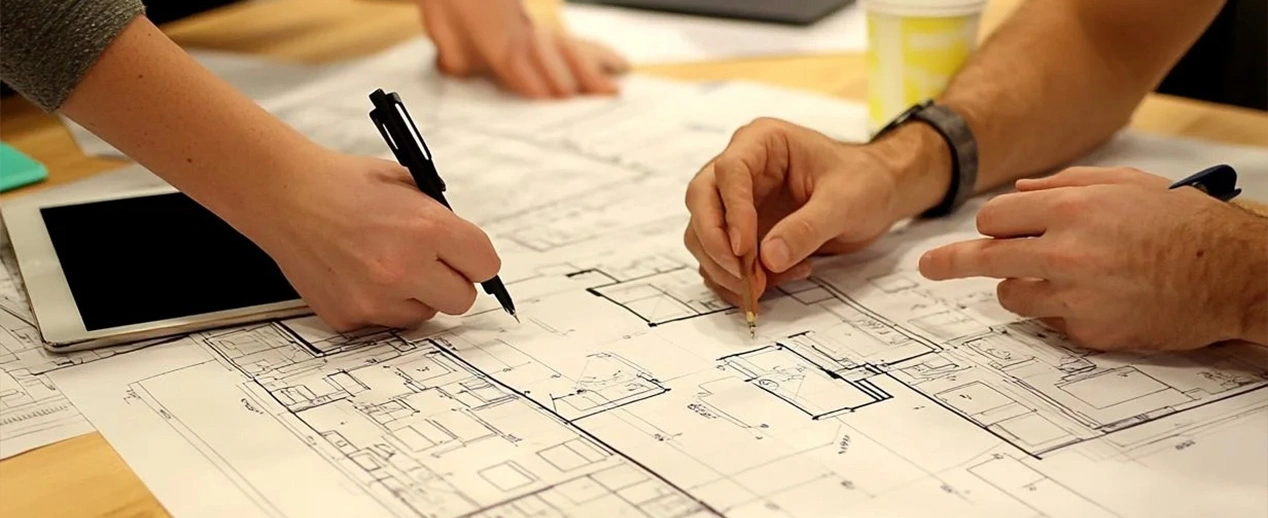
Not all drawing sets are created equal. Here is what separates a useful set of interior design working drawings from a set that creates more problems than it solves:
- Every dimension is called out. No wall, door, or niche is left unmeasured.
- All drawings are cross-referenced. The floor plan, ceiling plan, and electrical plan all align.
- Materials and finishes are specified by brand, code, and grade, not just by description.
- Custom joinery has section and detail drawings, not just a front elevation.
- Electrical load points are shown in relation to furniture placement.
- Plumbing points are coordinated with the tile and flooring layout.
- A revision history is maintained. Everyone works from the latest version.
This level of documentation is what professional architectural consultancy service deliver. It is not just drawing lines on a screen. It is a coordinated, buildable set of instructions that reduces risk at every stage of execution.
The Role of Architectural Consultancy Services in Cost Control
Many people associate architectural and design consultancies with aesthetics. The drawings, the mood boards, the material palettes.
But the real value of architectural consultancy services is in execution control.
A good consultancy does not just design a space. It produces documents precise enough that any qualified contractor can build the same result. It coordinates between trades before they arrive on site. It answers questions in drawings before those questions become problems.
Incomplete or unclear working drawings, omission of trade-specific details, and lack of communication between designers and contractors are among the leading causes of construction cost overruns. The costly consequences include rework, change orders, cascading delays, and compliance issues.
When a consultancy eliminates these causes, the savings go directly to the client.
How Colonelz Approaches This
Colonelz was founded by Col Biraj Sahay and Capt Lalita Sahay. The military background they bring to every project is not just a brand story. It is the actual way the firm operates.
In military operations, ambiguity costs lives. Unclear instructions lead to failure. The same discipline carries into how Colonelz manages documentation on every project.
Before a single worker shows up on site, the team works to ensure that:
- All trade drawings are complete and coordinated.
- Material schedules are finalised and vendor-locked.
- Site mobilisation happens only after the full drawing set is approved.
The result is fewer surprises, tighter timelines, and projects that stay close to the original budget.
It is also why Colonelz clients rarely deal with mid-project cost shocks. The planning happens upfront. The savings happen throughout.
So, Does This Apply to Smaller Projects Too?
Absolutely. In fact, for smaller projects, the impact is even more visible.
A ₹15 lakh apartment interior with poor drawings can easily balloon to ₹19 or ₹20 lakhs. A ₹15 lakh project with detailed drawings rarely goes above ₹16 lakhs, and often comes in under.
The common belief is that detailed drawings are only needed for large commercial projects. That is incorrect. Rework does not discriminate by project size. A misplaced partition wall costs just as much to redo in a 2BHK as in an office.
The right question is not "Is my project big enough to need good drawings?" The right question is "Can I afford the cost of not having them?"
References
- Construction Industry Institute, Rework Costs in Construction, construction-institute.org
- MyComply / Trimble, How Poor Design Drives Construction Rework, trimble.com
- Buildern, Construction Rework: Costs, Causes, and Solutions, buildern.com
- Milwaukee Tool / OneKey Resources, Construction Rework: Causes, Impact, Cost & How to Avoid, onekeyresources.milwaukeetool.com
- Autodesk, 6 Causes of Construction Cost Overruns & How to Prevent Them, autodesk.com
- International Journal of Innovation, Management and Technology, Causes of Cost Overrun in Construction Industry, ijmt.net
- KPMG, Global Construction Survey 2015, kpmg.com
- PolstonTax / Fohlio, Construction Cost Overruns: Common Contractual Causes and How to Prevent Them, fohlio.com
 Residential Turnkey
 Residential Design Consultation
 Residential Construction
 Commercial Turnkey
 Commercial Construction
 Workspaces & Offices
 Architectural Turnkey
 Architectural Consultation
 Retail & Hospitality