The Space Problem Is Real (And It Is Getting Worse)
Why do so many Gurugram apartments feel cramped even when they are not that small? The answer usually comes down to one thing: single-purpose furniture in a multi-purpose home.
A dining table that only serves dinner. A bed that only sleeps. A sofa that only sits. In a city where every square foot costs a small fortune, this kind of thinking wastes space that you have already paid a premium for.
Consider this: more than 60% of urban residential developments in India consist of apartments, and most of them follow standard floor plans that were not designed with modern lifestyles in mind. You need a home office now. You need a guest room sometimes. You need storage always. And you need it all within the same walls.
That is where multifunctional furniture steps in. Not as a trend. As a practical solution.
What Is Multifunctional Furniture, Really?
It is not just a sofa-cum-bed from a catalogue. Multifunctional furniture is any piece that is designed to serve more than one purpose without compromising on either. Done right, it is invisible. It does its job quietly and makes the home feel larger, more organised, and more intentional.
Here are the most impactful types for Gurugram apartments:
- Murphy Beds (Wall Beds): These fold into the wall during the day. A bedroom becomes a study. A guest room becomes a yoga space. One room, two lives.
- Storage Ottomans: They seat guests, rest tired feet, and hide everything from extra linen to charger cables. No extra cabinet needed.
- Extendable Dining Tables: Perfect for nuclear families that occasionally host. Compact on regular days, fully open when you need it. They eliminate the "where do we seat everyone" problem.
- Modular Sofas with Storage: Built-in drawers or hidden compartments under the base. Every seat becomes a storage unit.
- Lift-Top Coffee Tables: The work-from-sofa problem, solved. The surface rises to desk height. It doubles as a dining table for one and goes back down when you are done.
- Built-In Loft Beds with Desks Below: Common in children's rooms and smaller bedrooms. The sleeping area goes up. The study is below. Vertical space, finally used.
Gurugram: At the Centre of a Global Shift
The global multifunctional furniture market tells you everything you need to know about which direction urban homes are heading.
The Global Multifunctional Furniture Market was valued at USD 15.9 billion in 2024 and is estimated to grow at a CAGR of 4.9% to reach USD 25.4 billion by 2034, fuelled by a surge in urbanisation and the shift toward smaller living spaces.
In the Asia Pacific specifically, the trend is sharper. The multifunctional furniture market in the Asia Pacific is anticipated to grow at a CAGR of about 7.4% from 2024 to 2030, driven by rapid urbanisation and a growing middle class.
And in India, the demand is clearly outpacing supply. The Indian home furniture market was valued at USD 15.80 billion in 2024 and is projected to exhibit a CAGR of 7.90% during 2025–2033, reaching a value of USD 33.80 billion by 2033. A large part of that growth is being driven by the demand for compact and multifunctional designs, particularly in urban homes.
North India is envisioned to account for a share of about 42.1% of the Indian furniture market in 2025, attributed to the rising adoption of contemporary furniture across Noida, Delhi, Chandigarh, and Gurugram.
Gurugram is not just part of this story. It is at the centre of it.
Does Multifunctional Furniture Have to Look Cheap or Temporary?
This is the question most homeowners in Gurugram quietly worry about. They have seen the "space-saving" furniture sold online. It looks flimsy. It looks like a compromise. And it usually is.
But that is a product problem, not a design problem.
When multifunctional furniture is designed by someone who understands both structure and aesthetics, it does not look like a workaround. It looks like the room was always meant to be that way.
"Design is not just what it looks like and feels like. Design is how it works." — Steve Jobs
This principle is exactly why multifunctional furniture, when properly designed and installed, elevates a home instead of compromising it. The difference between furniture that looks like a clever fix and furniture that looks like a conscious design choice often comes down to who planned it.
That is the gap that a professional eye fills. And it is precisely what experienced turnkey interiors in Gurgaon teams handle from day one.
The Design Principles Behind Smart Space Planning
How do you know if your home actually needs multifunctional furniture, or if the space just needs to be rethought?
Most of the time, it is both. And one informs the other.
Here are the principles that guide good small-space interior design:
- Vertical space is always underused. Most apartments use the floor plan but ignore everything from the 7-foot mark upward. Tall shelving, wall-mounted units, and lofted elements change the entire feel of a room without touching the floor area.
- Zones matter more than rooms. A 2BHK does not have to have a dedicated dining room. A living zone can have a dining section built into it. Furniture placement and visual anchors do the work of walls.
- Light affects perceived space more than square footage. Mirrors, glass-front cabinets, and the right light placement can make a 900 sqft apartment feel considerably more open than it is.
- Custom always beats off-the-shelf. A sofa bought from a showroom fits a standard space. A sofa designed for your exact room fills it perfectly, adds storage where you need it, and leaves walking room where you need that too.
- Built-ins beat freestanding. Built-in wardrobes, wall-bed units, and floor-to-ceiling bookshelves make rooms look finished and intentional. They also tend to offer significantly more storage per square foot.
What This Looks Like in a Real Gurugram Apartment
Let us say you have a 3BHK in Sector 57 or DLF Garden City. Roughly 1,800 to 2,000 square feet. Two kids. You both occasionally work from home. You like hosting on weekends.
Here is how smart furniture design addresses each conflict:
- The spare bedroom has a wall bed. On weekdays, it is a proper home office with a desk and shelving. On weekends when family visits, the bed comes down, and the room switches its function entirely.
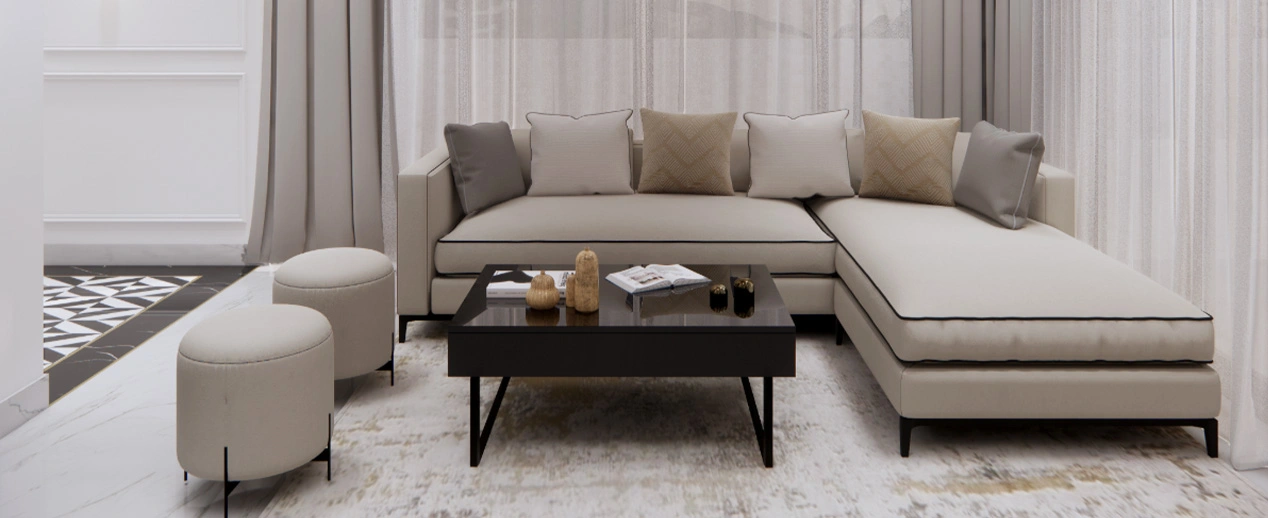
- The living room has a modular sofa with a built-in chaise that has under-seat drawers. The coffee table lifts to become a work surface or a casual dining table for two. No separate study chair needed.
- The children's room has a loft bed with a study desk and bookshelves below. The floor area under the bed is fully usable. The room, though compact, has everything a child needs without feeling overstuffed.
- The kitchen uses a fold-down breakfast counter on one wall. It seats two when needed and tucks away completely when not in use. The kitchen feels open. The counter only appears when it is needed.
None of this requires tearing down walls. It requires planning.
Why This Works Better With a Turnkey Partner
Here is something most homeowners only realise mid-project: multifunctional furniture only works when the entire space is planned together.
A Murphy bed that does not align with the room's electrical layout is a problem. A built-in sofa that blocks natural light is a different kind of problem. An extendable dining table that has nowhere to extend into is no solution at all.
This is why turnkey interiors in Gurgaon make such a difference for urban homes. When one team handles design, execution, civil work, furniture, and finishing together, every decision is connected. The furniture is not an afterthought. It is part of the plan from the very first layout drawing.
The growing nuclear families are catalysing the demand for compact, space-saving, and multifunctional furniture designs, and meeting that demand well requires coordination that goes beyond just ordering pieces from a catalogue.
This is where turnkey home interior contractors Gurgaon bring real value. They do not just install furniture. They design the space around the way you actually live, and then they build it that way.
Space-Saving Tricks Most Gurugram Homeowners Overlook
Most people know the popular hacks. Here are some things that do not come up as often:
- Raised flooring with hidden storage is a technique common in Japanese interior design but largely underused in Indian homes. A platform bed or raised living area with drawers underneath adds significant storage without any visible footprint.
- Folding walls and partition systems can turn a single large room into two private spaces. These are especially useful in open-plan apartments where a home office needs to feel separate without a permanent wall.
- Colour zoning replaces physical separation. Using different wall colours or flooring textures to define zones within the same room is an architectural trick that makes a space feel segmented and intentional without any construction work.
- The 60-30-10 rule in colour design is not just aesthetic. It also guides how furniture placement creates visual balance in small spaces, making rooms feel complete rather than chaotic.
- Acoustic panels that double as wall art are increasingly being used in compact apartments, especially home offices. They reduce sound and serve as a design feature simultaneously.
What to Look for When Planning Multifunctional Interiors
So how do you actually begin?
The process starts with honesty about how you use your home, not how you think you should use it. Here is a practical checklist:
- List every activity that happens in each room. Not just the intended one. The actual one.
- Identify which rooms feel the most cluttered. That is where storage is missing, not where more furniture is needed.
- Note which rooms feel unused during the day. Those are candidates for dual-function redesign.
- Think about who visits and how often. Guest accommodation is a recurring need in Gurugram households that rarely has a dedicated answer.
- Consider your five-year picture. Children's rooms change. Work habits change. Good interiors are designed with that in mind.
When you bring these answers to a team like Colonelz, the design process does not start with aesthetics. It starts with function. Style follows. And it follows naturally, because a well-planned space always looks good.
The Colonelz Approach to Space-Efficient Homes
Colonelz does not approach interiors as a decoration exercise. Every project starts with a detailed brief, a space analysis, and a design that reflects how the client actually lives. The team is founded by veterans who bring a precision-first mindset to every square foot of every project.
For urban Gurugram apartments, that means furniture that is built to the room, not bought from a catalogue. It means storage that is planned into the design rather than added as an afterthought. And it means a finished space where every element has a reason to be exactly where it is.
Whether you are working with a compact 2BHK or a spacious 4BHK that still has too many unresolved corners, turnkey interiors in Gurgaon done this way deliver homes that feel complete from the day you walk in.
That is the promise of smart design. And in a city where space costs what it does, it is not a luxury. It is the only sensible way to build a home.
References
- Magicbricks PropIndex Report, Q3 2024 — Property prices in Gurugram. Available at: magicbricks.com
- Grand View Research (2024) — Multifunctional Furniture Market Report 2024–2030. Available at: grandviewresearch.com
- IMARC Group (2024) — India Home Furniture Market: Industry Trends, Share, Size, Growth, Opportunity and Forecast 2025–2033. Available at: imarcgroup.com
- Globe Newswire / Future Market Insights (2025) — Multifunctional Furniture Industry Assessment 2025–2034. Available at: globenewswire.com
- Persistence Market Research (2025) — India Furniture Market Size, Share & Growth Trends, 2032. Available at: persistencemarketresearch.com
- Mordor Intelligence — Asia Pacific Multifunctional Furniture Market Trends. Available at: mordorintelligence.com
- UN Population Division — World Population Prospects. Available at: population.un.org
FAQs
1. What is multifunctional furniture, and is it suitable for standard Gurugram apartments?
Multifunctional furniture refers to pieces designed to serve more than one purpose, such as a wall bed that doubles as a study or a coffee table that lifts into a work desk. Yes, it is highly suitable for standard Gurugram apartments, especially 2BHK and 3BHK units, where space is premium but lifestyle needs are varied.
2. Does multifunctional furniture compromise on quality or aesthetics?
Not when it is custom-designed and professionally planned. Off-the-shelf pieces can look temporary, but furniture that is built specifically for your room, by a team that understands both structure and style, looks intentional and refined. The key is integration into the overall design plan, not treating it as an add-on.
3. How much space can smart furniture design realistically save in a Gurugram apartment?
A well-planned room using built-ins, wall beds, and modular storage can free up anywhere between 20% to 40% of usable floor space compared to a room filled with conventional single-purpose furniture. The exact gain depends on the room size, layout, and how many dual-function pieces are incorporated.
4. Should I plan multifunctional furniture before or after the civil work is done?
Always before. Multifunctional furniture, especially built-ins, wall beds, and raised platforms with storage, needs to be factored into the civil and electrical layout from the start. Planning it after civil work is complete often leads to compromises, for example, a wall bed that cannot go where you want it because a switchboard is in the way.
5. Can a turnkey interior contractor handle multifunctional furniture design along with the rest of the home?
Yes, and that is actually the most efficient approach. A turnkey partner plans furniture, civil work, storage, lighting, and finishing as one integrated system. This means every piece is designed to fit the specific room, not forced into a space it was not made for. It also means one point of accountability for the entire project.
 Residential Turnkey
 Residential Design Consultation
 Residential Construction
 Commercial Turnkey
 Commercial Construction
 Workspaces & Offices
 Architectural Turnkey
 Architectural Consultation
 Retail & Hospitality